
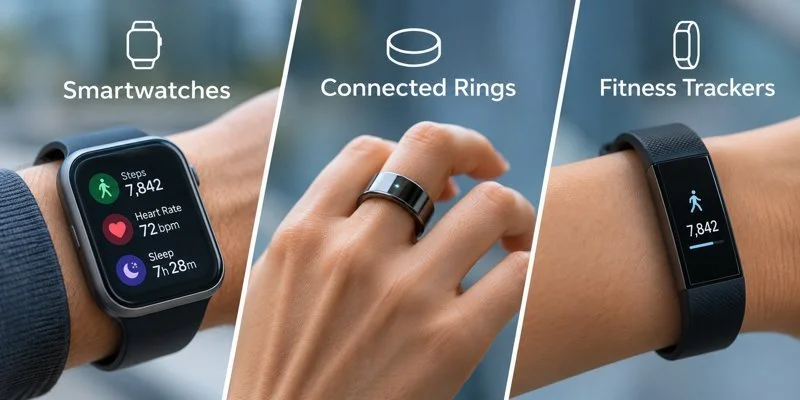
Consumer smartwatches, connected rings, and fitness trackers have fundamentally changed how we think about our health. From monitoring heart rate and sleep patterns to counting steps and estimating calories burned, these devices have made us more aware of our everyday behaviors.
But what happens when we move beyond measuring how much we move and begin to explore how well we move?
There is a fundamental difference between activity tracking and movement intelligence — and it is particularly evident in the science of gait.
The Limitations of Passive Tracking
Most consumer wearables rely on accelerometers and sophisticated algorithms to interpret movement. While these technologies serve a valuable purpose, wrist- and finger-based devices must often infer lower-body movement from upper-body activity.
Consider someone walking on a treadmill while holding the handrails, an older adult with a shortened stride, or a patient recovering from a stroke. In each of these scenarios, the relationship between upper-body movement and lower-body mechanics changes, potentially compromising the accuracy of the measurements.
Counting steps is one thing. Understanding the quality, symmetry, timing, and consistency of those steps is something entirely different.
When assessing mobility health, particularly in clinical environments, the distinction between estimating movement and directly measuring it becomes increasingly important.
The Difference Between Monitoring and Improving
Imagine receiving a notification on Monday morning informing you that your walking patterns were asymmetric last week. While that information may be valuable, the opportunity to correct that movement in the moment has already passed.
This is one of the inherent limitations of passive monitoring. It tells us what happened, but it does little to help us change what is happening.
Real-time biomechanical feedback introduces an entirely different dimension to mobility health. By providing immediate visual feedback, individuals can become more conscious of their movement patterns and make adjustments while they are actively walking.
This is particularly relevant to neuroplasticity — the brain's ability to reorganize and adapt its neural connections in response to experience, repetition, and learning. Immediate feedback combined with repetitive movement can support motor learning and the development of healthier movement patterns.
The timing of the information can be just as important as the information itself.
Turning the Treadmill Into a Real-Time Gait Lab
At Impower Health, we are approaching movement intelligence differently.
Rather than relying on wearable devices or upper-body movement estimates, our patented Gait Tracker™ technology captures footfall data directly from the treadmill with millisecond-level timing.
Through our Gait Index™ software platform, these measurements are translated into meaningful, real-time biomechanical insights, enabling individuals and clinicians to visualize movement patterns as they occur — without wearables, cameras, or additional devices attached to the body.
For rehabilitation professionals, this creates opportunities for more objective, personalized interventions. For fitness professionals, it introduces a new dimension of performance optimization. And for individuals, it provides greater awareness of how they move.
From Activity Tracking to Movement Intelligence
Wearable technology will continue to play an important role in the broader digital health ecosystem. But the next evolution of mobility health must extend beyond passive observation to active engagement.
What if every treadmill session became an opportunity to better understand your mobility, identify movement inefficiencies, and develop healthier walking patterns?
The future of mobility health isn't simply about collecting more data. It's about making that data actionable at the moment it matters most. It's time to move beyond measuring how much we move and start understanding how well we move.
Move beyond passive tracking. Discover the power of real-time biomechanical feedback at www.goimpower.com.