
The Mobility Gap: Why We Are Losing the War Against the Leading Cause of Disability
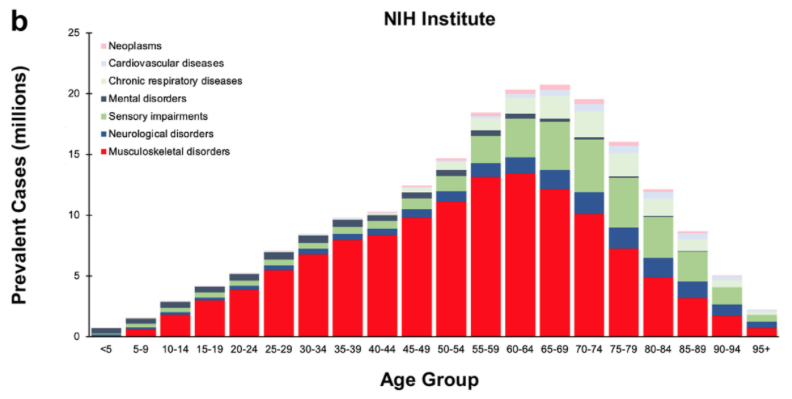
We are currently living through a biological paradox. We have never been more "health-aware" – our wrists are strapped with sensors, our phones are filled with fitness apps, and "longevity" is becoming a household term. Yet, the most significant driver of physical decline and healthcare spending in the United States is being systematically overlooked.
The Funding Paradox
A recent ecological study published in The Lancet highlights a staggering disconnect between the diseases that cost us the most and where we actually spend our research dollars. Between 2015 and 2019, while the total burden of musculoskeletal (MSK) diseases increased by 4.3%, the proportion of NIH funding allocated to study them actually decreased by over 10%.
The graph above tells a sobering story. For nearly every productive year of an adult’s life – specifically from ages 10 to 74 – musculoskeletal disorders comprise a staggering two-thirds of all prevalent disease cases. In 2019 alone, nearly 83 million adults in the U.S. aged 15–64 were living with an MSK disorder.
We are pouring resources into diseases associated with death, but we are neglecting the ones that cause decades of disability. In 2016, MSK diseases were the leading driver of healthcare spending in the U.S., with direct costs estimated at $381 billion. That exceeds the spending on diabetes ($309B), cardiovascular diseases ($255B), and even cancer ($123B).
The burden is growing, affecting more than one in three people in the U.S., approximately 127 million individuals. So, the question remains: How can YOU get – and stay – ahead of this curve?
Why Current Tools are Failing You
If we know the "MSK curve" is coming for us, why aren't we stopping it? The truth is that our current toolkit for "staying ahead" is fundamentally, and perhaps even comically, flawed.
1. The Wearable Myth
We have been sold the idea that a device on our wrist or a phone in our pocket can tell us how we move. It is a "crazy" proposition when you think about it. Your wrist cannot feel the millisecond variations in how your foot strikes the ground. It cannot measure the subtle shifts in your center of gravity or the specific symmetry of your gait. Trying to track leg and joint health from a wristband is like trying to diagnose a car’s transmission by listening to the radio; it is an indirect, low-fidelity guess at best.
2. Machines That Measure Themselves
Millions of us go to the gym specifically to "get ahead of the curve." We spend hours on treadmills designed to improve our health, yet the machine remains remarkably ignorant of the person standing on it. Today's treadmills report extensively on what the machine is doing – belt speed, incline, motor amps, and calories "burned" (another estimate). The treadmill knows everything about its own mechanical health and absolutely nothing about your biological health. You are walking on a powerful sensor platform that is currently acting as a blind observer.
3. The Access Barrier
When you finally do suspect something is wrong, the path to objective data is fraught with friction. You likely have to wait weeks for an outpatient rehab or physical therapy appointment. If you are lucky enough to gain access to a specialized gait lab, the assessment can cost thousands of dollars. Even then, these are mere "snapshots" in time – a single data point in a journey that spans decades. There is no repeatable, accessible way to monitor the micro-shifts in your mobility.
Moving from Observation to Intelligence
Staying ahead of the Lancet's curve requires a fundamental shift in perspective. We must move from subjective observation to Mobility Intelligence.
We don't need more gadgets or "wearable" clutter. We need the machines we already trust to start looking out for us. At Impower Health, we believe the equipment already under your feet should be your first line of defense.
This is the Impower shift. We are transforming the standard treadmill from a glorified hamster wheel into a high-fidelity diagnostic lab.
Imagine stepping onto a treadmill at your local gym or clinic. Instead of just seeing "3.5 MPH," the console displays your Gait Index™. In real-time, the machine analyzes your symmetry, your stability, and your timing. It alerts you to subtle biomechanical changes – the kind you can't feel yet – months before they manifest as a chronic MSK disorder or a clinical injury.
By integrating Mobility Intelligence directly into the treadmill's DNA via low-friction APIs and our Gait Tracker™ module, we make advanced analytics as accessible and ubiquitous as a heart rate monitor.
Our Vision: Standardizing the 6th Vital Sign
We are losing the war against MSK disability because we haven't had a way to measure the battlefield. By the time most people realize they are on the "wrong side of the curve," the damage is done.
Imagine a different world.
Imagine a world where that Lancet graph begins to trend downward because we caught the "micro-shifts" in our 30s, 40s, and 50s. Imagine your 60s looking and feeling like your 40s because you had the objective data to course-correct before a minor asymmetry turned into a major hip or knee replacement.
This is the power of standardizing Gait is the 6th Vital Sign™. Just as blood pressure monitors your heart and oxygen levels monitor your lungs, Mobility Intelligence monitors your life's most essential asset: your independence.
The Lancet data is a wake-up call, but it is not a destiny. The "Mobility Gap" exists because we’ve been looking at the wrong data in the wrong places. It’s time to stop guessing and start knowing.
Are you ready to see what your movement is actually telling you?
[Watch the 2-Minute Demo] and see how Impower Health is turning the machines you already use into the ultimate tool for staying ahead of the curve.